


April 13, 2026 •Olivia Hebner
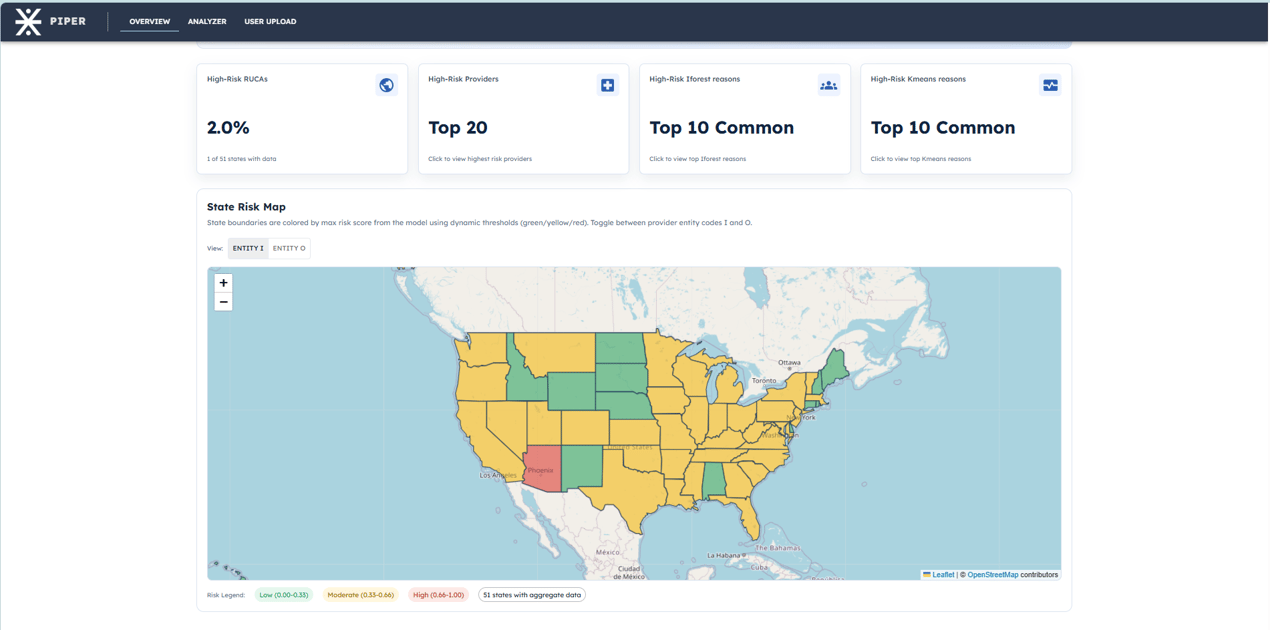
The recent American Council for Technology - Industry Advisory Council (ACT-IAC) AI Hackathon united technologists, data scientists, and public sector leaders in tackling a top government challenge—using AI responsibly to boost mission outcomes. Team Summit joined this competition to explore how modern machine learning and cloud-native architecture can drive federal agencies from reactive processes to proactive, data-driven decision-making.
For this challenge, Team Summit chose a Centers for Medicare & Medicaid Services (CMS) use case: Design a solution to help CMS identify anomalous provider billing behavior using publicly available data, without relying on pre-labeled fraud cases. In just two weeks, we built PIPER—a working prototype showcasing AI’s power to boost program integrity at scale.
PIPER is an AI-powered machine learning analytics platform that helps CMS swiftly identify and prioritize potentially anomalous Medicare Part B providers for review. Using unsupervised machine learning, PIPER detects unusual billing behaviors without labeled fraud data. This makes the approach scalable and adaptable to evolving patterns, which directly advances CMS’s broader shift from traditional “pay-and-chase” models to proactive fraud, waste, and abuse prevention.
At its core, PIPER merges two complementary models—Isolation Forest and K-Means clustering—to evaluate provider behavior across service volume, procedure mix, cost patterns, growth trends, beneficiary characteristics, and other key dimensions.
Each model independently compares providers to peer groups defined by specialty, geography, and service patterns. This comparison generates anomaly-based risk signals, which combine into a clear, composite risk score reflecting the likelihood of atypical or potentially fraudulent behavior. PIPER was built to meet key hackathon requirements:
PIPER demonstrates how thoughtful, transparent AI helps government agencies protect taxpayer dollars, boost oversight, and build trust in public programs.
PIPER turns raw CMS data into actionable insights through an end-to-end, cloud-based pipeline. Analysts can track risk signals across time, geography, and peer groups—and understand why a provider was flagged. This transparency is crucial. Program integrity decisions must be defensible, auditable, and explainable. PIPER highlights the specific drivers behind each anomaly and enables side-by-side peer comparisons. The result is a system that helps CMS accomplish the following:
While developed as a hackathon minimum viable product (MVP), Team Summit deliberately designed PIPER for real-world deployment. PIPER’s architecture enables the following potential enhancements:
This outcome reflects a core driver in our participation: Hackathon participants can do more than generate ideas—they can deliver scalable, realistic solutions.
PIPER is more than just a prototype. It shows how thoughtful, transparent AI helps government agencies protect taxpayer dollars, boost oversight, and build trust in public programs. As CMS and other agencies invest in AI-driven decision support, solutions like PIPER offer a clear, explainable, scalable, and mission-aligned path forward.
Check out a live version of PIPER here: https://cms-ml-dev.summit-app-demo.com/